XHT-M06 · FIELD TEST INSTRUMENTS
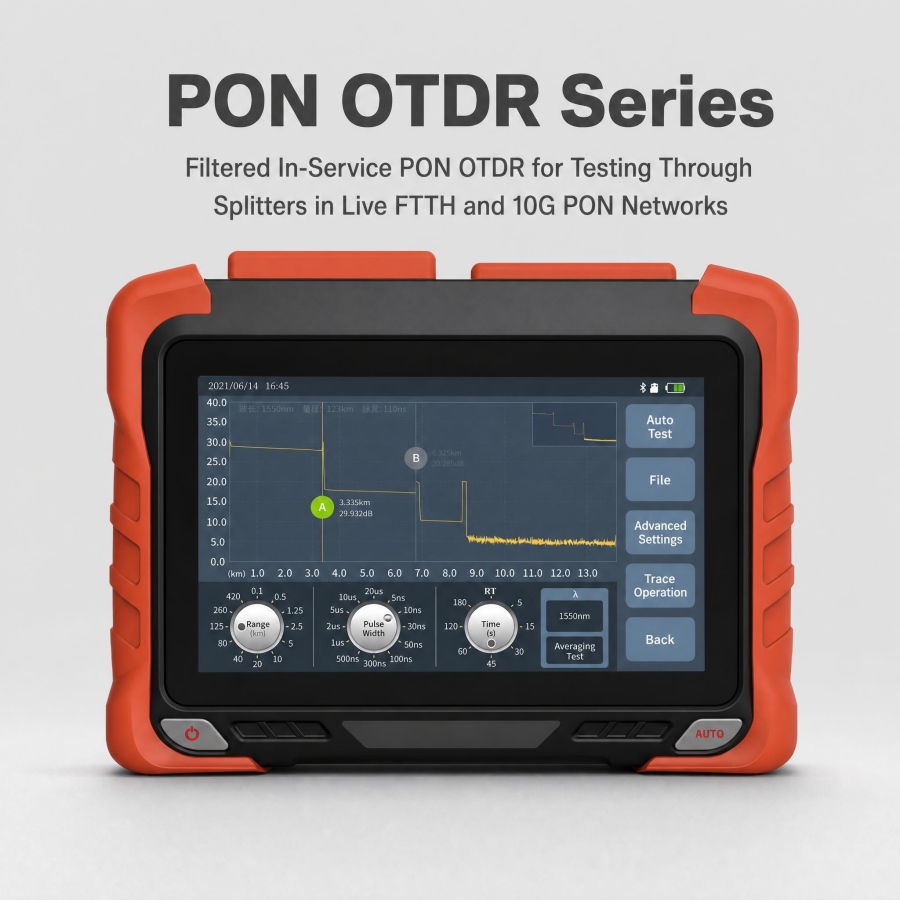
PON OTDR Series
Filtered in-service PON OTDR for testing through splitters in live FTTH and 10G PON networks.
1 platform · 7 modules · up to 42 dB · in-service through 1:64 splitters
A PON OTDR uses a filtered, out-of-band pulse — 1625 nm for GPON/EPON, 1650 nm for XGS-PON/10G PON — to test through splitters on a live network without dropping subscribers, plus 1310/1550 nm for dark-fiber acceptance. Dynamic range — not the maximum selectable range — governs splitter penetration and reachable distance.
Handheld PON OTDR XHT-M06-PON6200
|
In-service testing through splitters
Filtered 1625/1650 out-of-band ports test through up to 1:64 splitters on a live network with no subscriber outage.
|
0.5 m ultra-short event dead zone
Resolves 3 m patch cords and densely spaced connectors that longer-dead-zone OTDRs merge into one event.
|
|
Live-fiber detection & APD protection
Active traffic detection warns of live fiber and protects the APD detector, preventing damage and saturated traces.
|
Multi-wavelength test & auto diagnosis
One-tap test acquires all wavelengths together and auto-analyzes splitter, splice, bend and break events on an event map.
|
|
All-in-one field platform
OTDR, OPM, OLS, VFL, event map, loss test, connector inspection (optional), Ethernet (Ping/PPPoE) and remote test in one unit.
|
SOR batch workflow & smartphone app
Native SOR batch processing with auto-save; wireless app control, data sharing and report printing.
|
Module Selection Guide
All modules are G.652 single-mode. Choose by (1) offline acceptance vs in-service maintenance, (2) PON generation (GPON/EPON → 1625; XGS-PON/10G PON → 1650), and (3) required dynamic range. Filter isolation is > 40 dB on every live port.
| Module |
Wavelengths & filter |
Dynamic range |
Best-fit application |
| DUAL-WAVELENGTH OFFLINE — DARK FIBER ACCEPTANCE |
| PD1 |
1310/1550 nm ±20, unfiltered (offline) |
37/35 dB |
Dark/tier-down fiber and access links; standard dual-wavelength loss certification; entry configuration |
| LIVE 1625 nm — GPON / EPON (HIGH-PASS >1595 nm) |
| PS1 |
1625 nm ±20, high-pass >1595 nm (live) |
38 dB |
Dedicated in-service maintenance of GPON/EPON (1310/1490/1550); single out-of-band live port |
| PT1 |
1310/1550 + 1625, high-pass >1595 nm |
38/36/36 dB |
All-in-one: dark-fiber acceptance plus GPON/EPON live maintenance; standard dynamic range |
| PT2 |
1310/1550 + 1625, high-pass >1595 nm |
40/38/38 dB |
Acceptance plus GPON/EPON live maintenance; higher range for higher split / higher loss |
| PT3 |
1310/1550 + 1625, high-pass >1595 nm |
42/40/40 dB |
Highest dynamic range for deep GPON splits, high-loss links and metro P2P |
| LIVE 1650 nm — XGS-PON / 10G PON (BAND-PASS 1650±7 nm) |
| PS2 |
1650 nm ±5, band-pass 1650±7 nm (live) |
38 dB |
Dedicated in-service maintenance of XGS-PON/10G PON, avoiding the 1577 nm downstream band |
| PT4 |
1310/1550 + 1650, band-pass 1650±7 nm |
38/36/36 dB |
Acceptance plus 10G PON live maintenance; standard dynamic range |
Filter isolation > 40 dB (1270–1585 nm for the 1625 high-pass; 1650±7 nm for the band-pass). Dynamic range figures are listed per wavelength in the order printed on the unit (1310/1550/live). In-service splitter penetration up to 1:64 under standard splitter loss.
| Fiber type | G.652 single-mode |
| Wavelength modules | PD1, PS1, PS2, PT1, PT2, PT3, PT4 (see Module Selection Guide) |
| Live filter | 1625 nm: high-pass >1595 nm; 1650 nm: band-pass 1650±7 nm; isolation > 40 dB |
| Maximum dynamic range | Up to 42/40/40 dB (PT3); 37–40 dB across other modules |
| In-service splitter penetration | Up to 1:64 through passive splitters (standard splitter loss) |
| Event dead zone | 0.5 m (3 ns pulse, reflectance −35 to −55 dB) |
| Attenuation dead zone | 3.5 m (3 ns pulse, reflectance −55 dB at 1310 nm) |
| PON dead zone | 30 m |
| Distance range | 100 m / 500 m / 1.25 / 2.5 / 5 / 10 / 20 / 40 / 80 / 125 / 260 / 420 km |
| Pulse widths | 3 ns – 20 µs (3/5/10/20/30/50/80/100/200/300/500/800 ns, 1/2/3/5/8/10/20 µs) |
| Distance accuracy | ± (0.75 m + sampling interval + 0.0025% × distance); excludes refractive-index uncertainty |
| Sampling points / resolution | ≥ 256,000 / 0.015 m – 16 m |
| Loss accuracy | 0.03 dB/dB |
| Loss resolution / threshold | 0.001 dB / 0.01 dB |
| Reflection accuracy | ± 2 dB |
| Loss measurement | 4-point / 5-point method |
| File format | SOR standard trace |
| Real-time refresh | 4 Hz |
| Laser safety class | Class II |
| Optical connector | FC/UPC standard (SC/ST interchangeable); FC/APC on request |
| Optical power meter | 800–1700 nm; −50 to +26 dBm / −70 to +6 dBm; ±5%; calibrated 850/980/1300/1310/1490/1550/1625/1650 nm; FC/SC/ST universal adapter |
| Stable light source | FP-LD, same wavelengths as OTDR; ≥ −5 dBm (single-mode); CW/270/1k/2k Hz; ±0.05 dB/15 min |
| Visual fault locator | 650 nm ±20 nm; ≥ 10 mW; CW/1 Hz/2 Hz |
| Ethernet / copper test | Ping / PPPoE, cable length, wire map and tone tracing up to 300 m |
| End-face inspection | Probe-based connector end-face inspection (probe sold separately) |
| Smartphone app | Bluetooth/Wi-Fi wireless control, data sharing and test-report printing |
| Display | 7 in capacitive touch color LCD, 800 × 480 |
| Data storage | Internal 2 GB (≥ 200,000 traces); external storage up to 64 GB |
| Data interfaces | USB-A, USB Type-C, RJ45 LAN 10/100 Mbit/s |
| Power supply | 3.7 V / 10,400 mAh Li-ion; Type-C adapter (5V/3A, 9V/2A, 12V/1.5A); power-bank supported |
| Integrated functions | OTDR, power meter, VFL, light source, event map, loss test, end-face inspection (optional), Ethernet test, remote test, file management |
| Dimensions | 215 mm (W) × 160 mm (H) × 50 mm (D) |
| Weight | ≤ 1.2 kg |
| Operating / storage temperature | −10 to +50 °C / −40 to +70 °C; 0–95% RH non-condensing |
| MOQ | 1 pc |
| Reference lead time | 7 days |
FAQ
Q1. Why does a PON OTDR use 1625 or 1650 nm? These are filtered out-of-band wavelengths. A built-in filter (>40 dB isolation) rejects the live traffic while the OTDR pulse passes through the splitter, so faults can be located on a live network without affecting other subscribers. Unfiltered 1310/1550 wavelengths must only be used on dark fiber.
Q2. Which live wavelength do I need — 1625 or 1650? 1625 nm serves GPON/EPON (1310/1490/1550). 1650 nm is required for XGS-PON/10G PON, because it sits clear of the 1577 nm downstream band. Confirm the PON generation before ordering.
Q3. Which module should I order? PD1 for acceptance-only and PS1/PS2 for dedicated live maintenance; the combined PT modules do both. For GPON/EPON, PS1 is the single 1625 port and PT1/PT2/PT3 combine 1310/1550 with 1625 at 38/36/36, 40/38/38 and 42/40/40 dB (PT3 is the highest-range flagship). For XGS-PON/10G PON, PS2 is the single 1650 port and PT4 combines 1310/1550 with 1650 at 38/36/36 dB.
Q4. What splitter ratio can it test through? Up to 1:64 in-service under standard splitter loss.
Q5. How does this differ from the handheld XHT-M05 OTDR? XHT-M05 is a 20–26 dB pocket/access tool for last-mile fault finding and cannot test through a live splitter. XHT-M06 is a filtered PON platform (up to 42 dB) that tests in-service through splitters; the two are complementary, not interchangeable.
Q6. MOQ, lead time and accessories? MOQ 1; reference lead time 7 days. FC/APC connectors, the inspection probe, Ethernet test leads and bulk orders are arranged on request. Each unit ships with the main unit (battery included), AC/DC adapter, USB drive, data cable, SC adaptor, certificate, cleaning wipes, strap and carry bag.
Ordering
• Part number: XHT-M06-PON6200-[PD1 / PS1 / PS2 / PT1 / PT2 / PT3 / PT4].
• Orders are confirmed against the PON generation, module, splitter ratio and connector type before packing; live wavelength capability is verified against the network conditions.
To recommend the correct PON OTDR: tell us the PON generation (GPON/EPON vs XGS-PON/10G PON), the maximum splitter ratio and link loss, whether offline acceptance at 1310/1550 is also required, and whether Ethernet testing is needed.
Related Products
• Handheld OTDR (last-mile, access) → XHT-M05
• Live XGS-PON power meter (1270/1577) → XHT-M02
• Optical power meter → XHT-M01
• Visual fault locator → XHT-M03
• Optical light source → XHT-M04
• Fiber inspection microscope → XHT-M07